English

Blaise Pascal
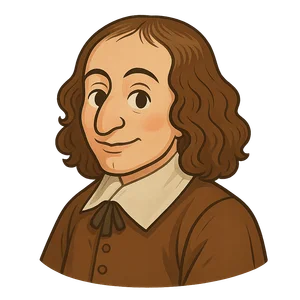
Blaise Pascal was a French mathematician, physicist, inventor, philosopher…
Reads at Grades 3–5 Listens at Grades 1–5
Print & create
Answer keys·No prep·Free with an account
28 worksheets · answer keys · full story · quiz · Ages 8-10 · CEFR B1
Plus adds 279,000+ more stories in 27 languages, audio for every one, and printables for all of them.
Just want Blaise Pascal?
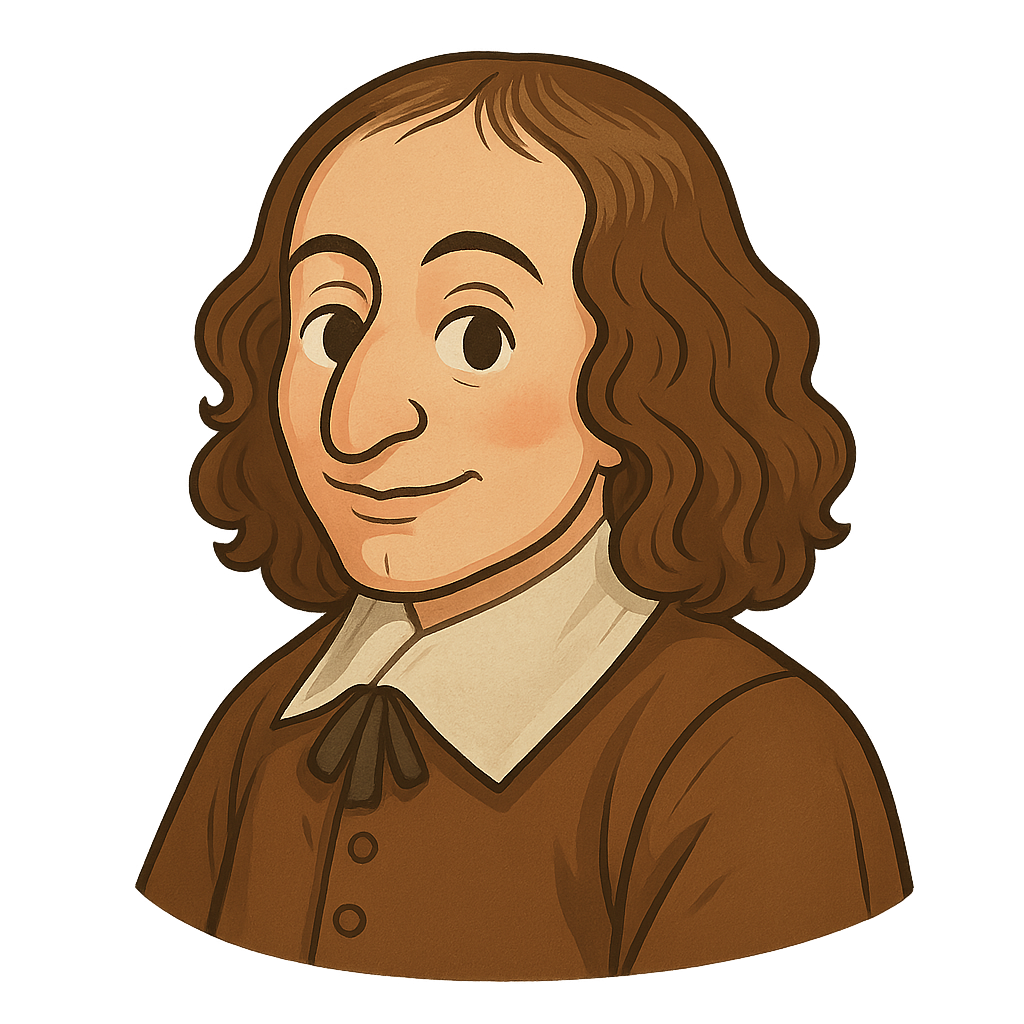
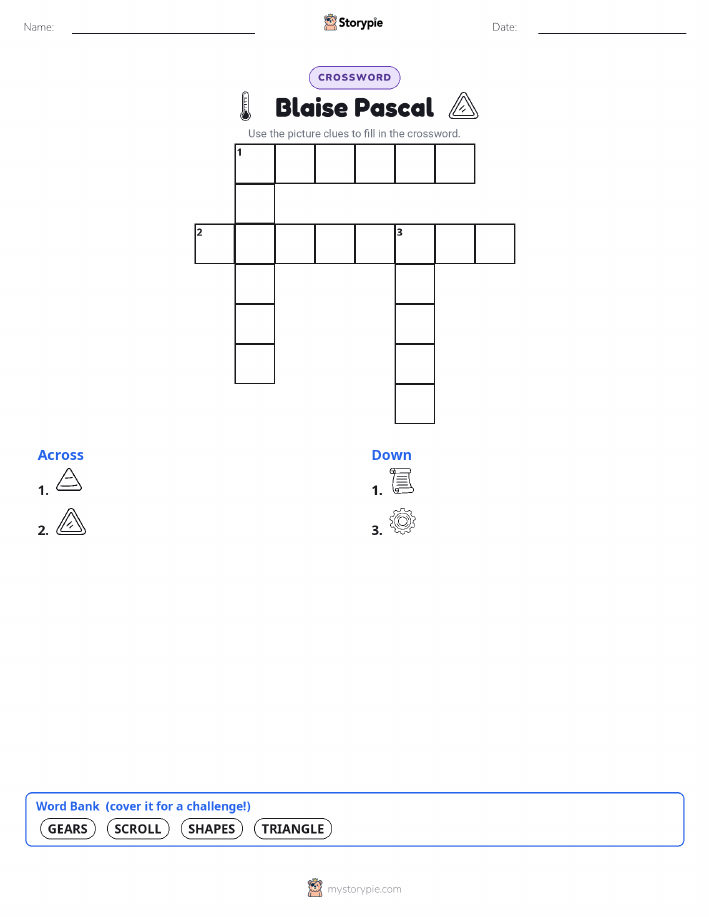
Hello, my name is Blaise Pascal. My story begins on June 19th, 1623, in a town in France called Clermont-Ferrand. My father, Étienne, was a tax collector who loved mathematics, but he had a surprising rule for me: no math until I turned 15! He wanted me to master subjects like Latin and Greek first, believing a strong foundation in those would make learning everything else easier. But my curiosity was far too strong to be held back. When I was just 12 years old, around the year 1635, I couldn't wait any longer. I secretly started exploring shapes and lines all on my own. Using just a piece of charcoal on the floor, I figured out many of the basic rules of geometry without ever reading a book about it! One day, my father discovered my secret notebook filled with drawings of triangles and circles. He was so astonished and proud that he changed his rule. He handed me a real geometry book, and my journey into the world of numbers officially began.
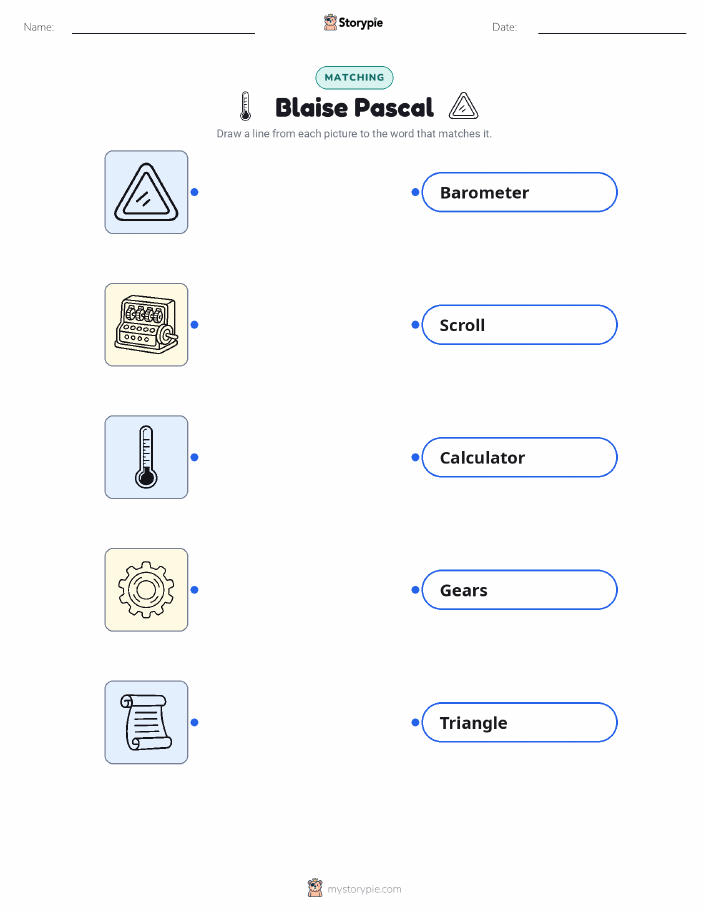
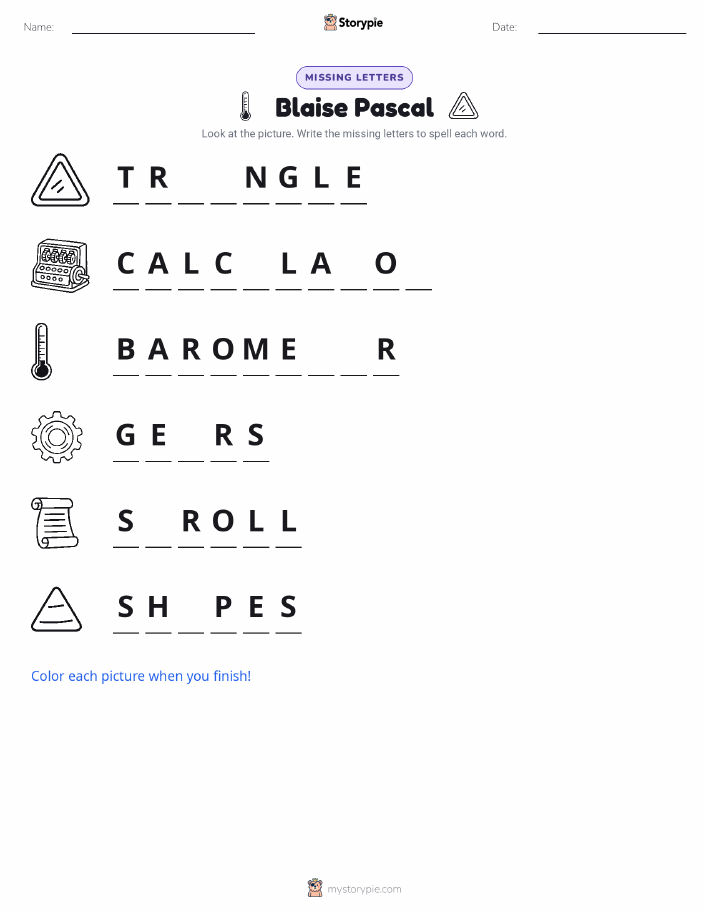
I loved helping my father, but I saw how tiring his job was. As a tax collector, he had to add endless columns of numbers by hand, day after day. It was slow and difficult work, and mistakes were easy to make. I thought to myself, 'There must be an easier way!' So, starting in 1642, when I was 19 years old, I began designing a machine that could do the hard work for him. It was a beautiful brass box full of spinning wheels and gears, carefully designed so that each turn of a dial would perform addition or subtraction. After working on it for a few years, I finally built my invention and called it the Pascaline. It was one of the world's first mechanical calculators! It was a great help to my father and many others, and it showed how clever machines could be used to solve human problems.
Blaise Pascal: A Curious Mind
Hello, my name is Blaise Pascal. My story begins on June 19th, 1623, in a town in France called Clermont-Ferrand. My father, Étienne, was a tax collector who loved mathematics, but he had a surprising rule for me: no math until I turned 15! He wanted me to master subjects like Latin and Greek first, believing a strong foundation in those would make learning everything else easier. But my curiosity was far too strong to be held back. When I was just 12 years old, around the year 1635, I couldn't wait any longer. I secretly started exploring shapes and lines all on my own. Using just a piece of charcoal on the floor, I figured out many of the basic rules of geometry without ever reading a book about it! One day, my father discovered my secret notebook filled with drawings of triangles and circles. He was so astonished and proud that he changed his rule. He handed me a real geometry book, and my journey into the world of numbers officially began.
I loved helping my father, but I saw how tiring his job was. As a tax collector, he had to add endless columns of numbers by hand, day after day. It was slow and difficult work, and mistakes were easy to make. I thought to myself, 'There must be an easier way!' So, starting in 1642, when I was 19 years old, I began designing a machine that could do the hard work for him. It was a beautiful brass box full of spinning wheels and gears, carefully designed so that each turn of a dial would perform addition or subtraction. After working on it for a few years, I finally built my invention and called it the Pascaline. It was one of the world's first mechanical calculators! It was a great help to my father and many others, and it showed how clever machines could be used to solve human problems.
My curiosity didn't stop with numbers and machines. I became fascinated by the invisible world around me, especially the air we breathe. At that time, many scientists were having a big debate about whether a vacuum—a space with absolutely nothing in it—could truly exist. I believed it could, and I had an idea for an experiment to help prove that the air itself has weight and pressure. In 1648, I asked my brother-in-law to climb a tall mountain called Puy de Dôme. He carried a special instrument called a barometer, which measures air pressure, all the way to the top. Just as I had predicted, the barometer showed that the air pressure was much lower at the peak of the mountain than it was at the bottom. This famous experiment helped prove that we live at the bottom of a huge sea of air.
My mind was always looking for a new puzzle to solve. Around the year 1654, a friend came to me with a tricky question about a game of chance. He wanted to know how to divide the prize money fairly if a game had to be stopped before it was finished. This was a very interesting problem! To solve it, I started writing letters to another brilliant mathematician named Pierre de Fermat. We exchanged many ideas and worked through the puzzle together. Through our letters, we figured out the mathematics behind chance and luck. Our work became the foundation for something called probability theory, which helps us understand and predict how likely things are to happen. It’s a field of math that is still used today in weather forecasting, scientific studies, and even in creating your favorite games!
Throughout my life, I loved to explore big questions about science, numbers, and faith. I was always thinking and writing, and I filled notebooks with my private ideas and wonderings about the world. After my life ended, these notes were collected and published as a famous book called 'Pensées,' which means 'Thoughts' in French. I lived to be 39 years old. Though my time on Earth was short, my curiosity led to ideas that are still very important today. The Pascaline was an early step toward the computers we all use, and my discoveries about pressure and probability are still a key part of science and math. I hope my story reminds you that asking questions is one of the most powerful and exciting things you can do.
Wow facts
About
Blaise Pascal was a French mathematician, physicist, inventor, philosopher, and writer who made foundational contributions to probability theory, projective geometry, and the study of fluids and pressure.
Take a Quiz
Question 1 of 5
Why did Blaise Pascal invent the Pascaline?
Explore next



Want to do even more?
Go beyond exploring. Unlock tools that turn every story into real learning.

Storypie Plus for families
Full stories, quizzes, and printables. Nights and car rides, sorted.
- Unlimited audio stories
- Create Mode: your child stars in the story
- Offline downloads
- Printable worksheets & coloring pages

Why Storypie for Schools
Students engaged. Prep in seconds. Evenings back to you.
- Worksheets & Quizzes
- Classroom Management
- Formative Assessment
- Custom Curriculum & Lesson Plans
- 27 Languages

Why Storypie for Homeschool
Curriculum done. They'll ask for more. Hours back in your day.
- Worksheet Generator
- First-Person Audio Stories
- Built-in Comprehension Quizzes
- Custom Curriculum & Lesson Plans
- Print & Go Activities